
The Des Moines Public Library collection page comes first, because it sorts the available historical formats before any name search begins.
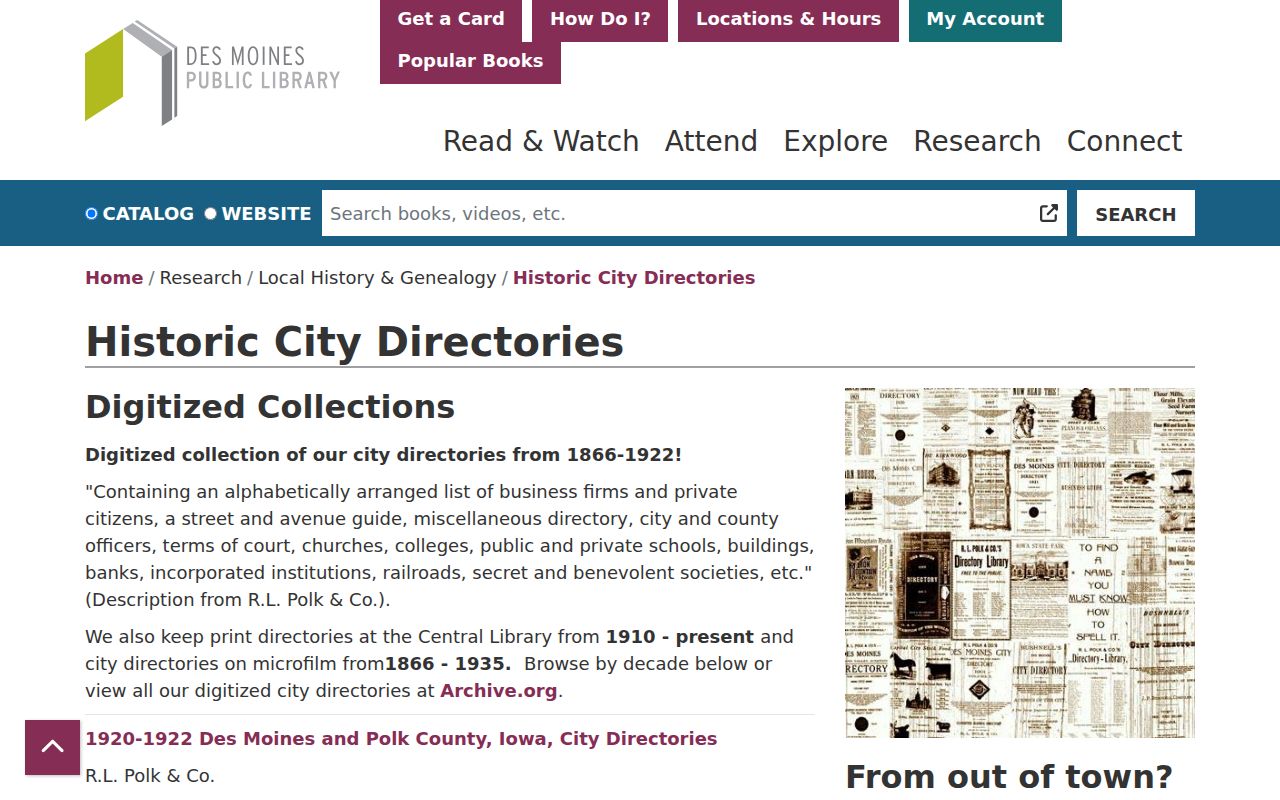
Scans, print books, microfilm, and phone books each carry different years, so know your format first.
West Des Moines Directory Shelves
Directory work in West Des Moines means juggling several collections. There is no single tidy town series. The Des Moines Public Library historic directory collection holds the longest dated run of them all. Digitized books cover 1866 through 1922. Print volumes from 1910 onward sit at Central Library. Microfilm fills 1866 through 1935. Des Moines telephone books run from 1957 to the present. All of it leans toward Des Moines and Polk County. The focus stays there. So coverage of Valley Junction and the later West Des Moines has to be confirmed volume by volume.
| Historical collection | Years documented | Repository | Access route |
|---|---|---|---|
| Digitized directories | 1866–1922 | DMPL links | Free page images |
| Print shelf | 1910–present | Central Library | In person |
| Directory microfilm | 1866–1935 | Central Library | Film readers |
| Suburban directories | 1963–2002 | Polk Central Services | Staff request |
| WDM/Polk City run | 1998–2002 | Polk Central Services | Staff request |
| Telephone books | 1957–present | Central Library | In person |
No public source offers a complete West Des Moines-only run. A miss outside the named years only means the name failed to appear in the item inspected, not that the person never lived there. Log the title, publisher, year, page, spelling, and whether the entry says Valley Junction, West Des Moines, or another postal label.
Publishers of West Des Moines Directories
The publisher names shift as the metro grew. Mills & Co. shows up for 1866 and 1869. J.P. Bushnell supplied listed books across the 1870s and 1880s, including 1871, 1873, 1876, 1877, 1879, and selected years from 1881 through 1889. R.L. Polk dominates the later digitized shelf. Its documented run includes 1892 through 1895, 1898 and 1899, every listed year from 1900 through 1917 except a separate 1918 gap, then 1919 through 1922. Leave the publication gaps visible. Never smooth them into a false span. The digitized 1920 Des Moines and Polk County City Directory makes a useful sample. Entries there separate business and home addresses, and some shorten Valley Junction to “Val Junc.”
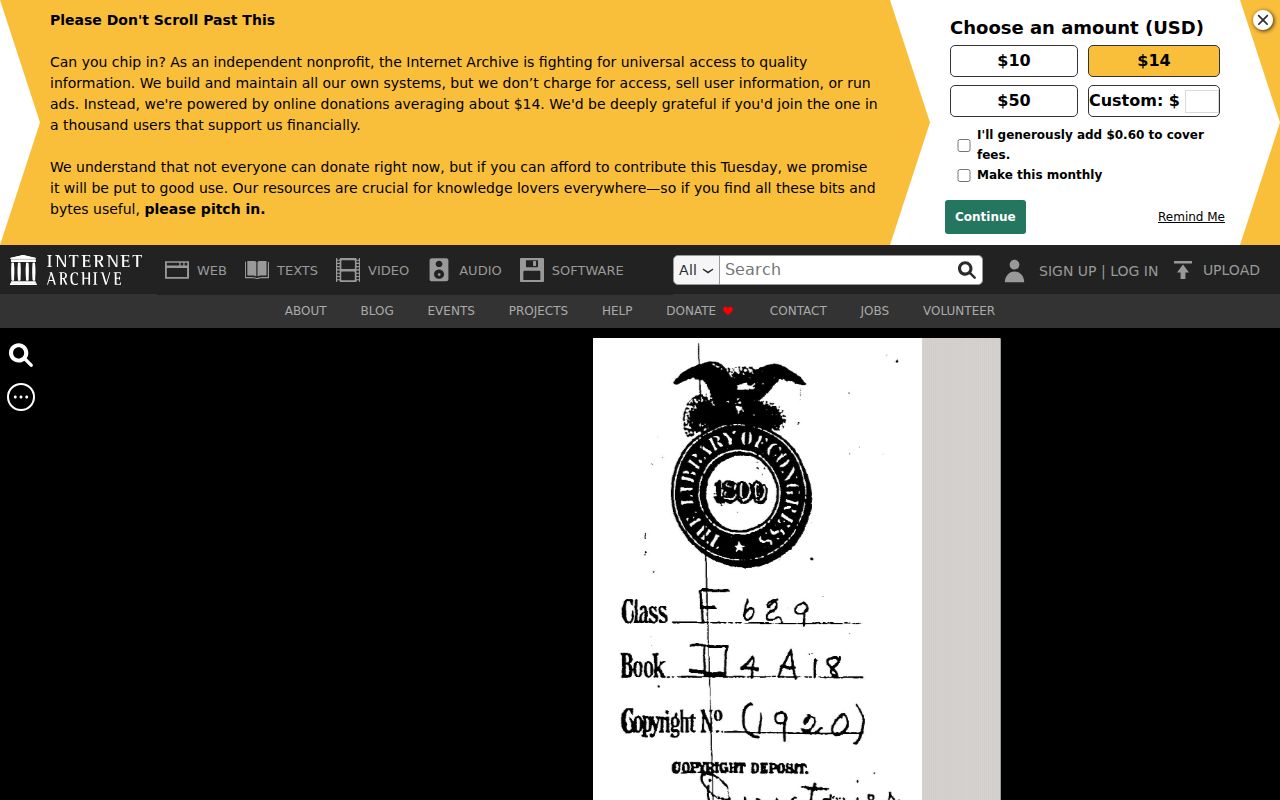
A scanned image settles every question. When a text search turns up a hit, match it against the type itself, since initials, street names, and place abbreviations garble easily in OCR.
Read West Des Moines Directory Entries
Each West Des Moines city directory entry squeezes a lot into one line. Read the publisher's key first. The name often carries a trade or employer after it. Business address, home address, phone, and a household notation may follow. The abbreviations follow the publisher's own form: “res” means resides, “bds” means boards or lodges, and “wid” marks a widow. A work location and a home are two separate facts, even when the scanned text runs them together.
| Printed name | Keep the exact surname, initials, and suffix before normalizing. |
|---|---|
| Occupation | Can separate people who share a name. |
| Business address | A work site, not proof of a household. |
| Residence | The house number and street printed for that year. |
| Notation | Short forms must be read through the volume's key. |
| Page and year | The citation needed to return to the image. |
Later directories allow a reverse search. Work backward from a street address to the named householder. That trick helps when a surname changed spelling or resists easy reading. Remember the entry is a year-specific listing. It is not a claim about who lives at the address today.
- Criss-cross directory
- A book arranged by street and house number, not just surname.
- Householder index
- An address-order list pointing to the person or household printed for that year.
- Abbreviation key
- The publisher's guide to the short forms and symbols in that book.
- OCR
- Machine-read scan text that must be checked against the page image.
West Des Moines Archive Partners
The West Des Moines Public Library, at 4000 Mills Civic Parkway, offers a local starting point for Iowa Files and staff help. Its phone number is 515-222-3400. The library publishes no public page confirming a complete local city directory shelf. Call before planning a visit around one year. Ask about the date, the format, the place label, and on-site rules.
The West Des Moines Historical Society online collection adds newspapers, obituaries, yearbooks, photographs, manuscripts, oral histories, and material tied to Jordan House and Bennett School. Its catalog keeps growing. It is not a townwide name index, so treat it as one thread of a residents directory search rather than the whole fabric.

A catalog entry can fill in what a brief directory line leaves out.
Valley Junction Directory Name Quirk
Searching older West Des Moines city directories sometimes takes two tries. Valley Junction incorporated in 1893. Residents accepted the West Des Moines name in late 1937. Print habits lagged behind the change. So one person may sit under Valley Junction, "Val Junc," or West Des Moines. Others may sit under a broad Polk County heading.
Cite the old label as printed. Then add a separate modern place field. Fifth Street anchors a search well, since it anchored the rail and business district. Still, a matching street number and name does not prove two records describe the same parcel. Only deeds, plats, and map context can build that bridge between entries.
Newspapers Extend West Des Moines Directories
A directory gives you a name and address on one date. Newspapers tell the story between editions. The Des Moines Public Library newspaper and magazine index covers a Register index for 1986–2020, an obituary index for 1960–2020, Tribune holdings with indexes, a street-naming index, and a pictures index. Pull the full article before treating an index hit as proof of a move, death, business, or family tie.
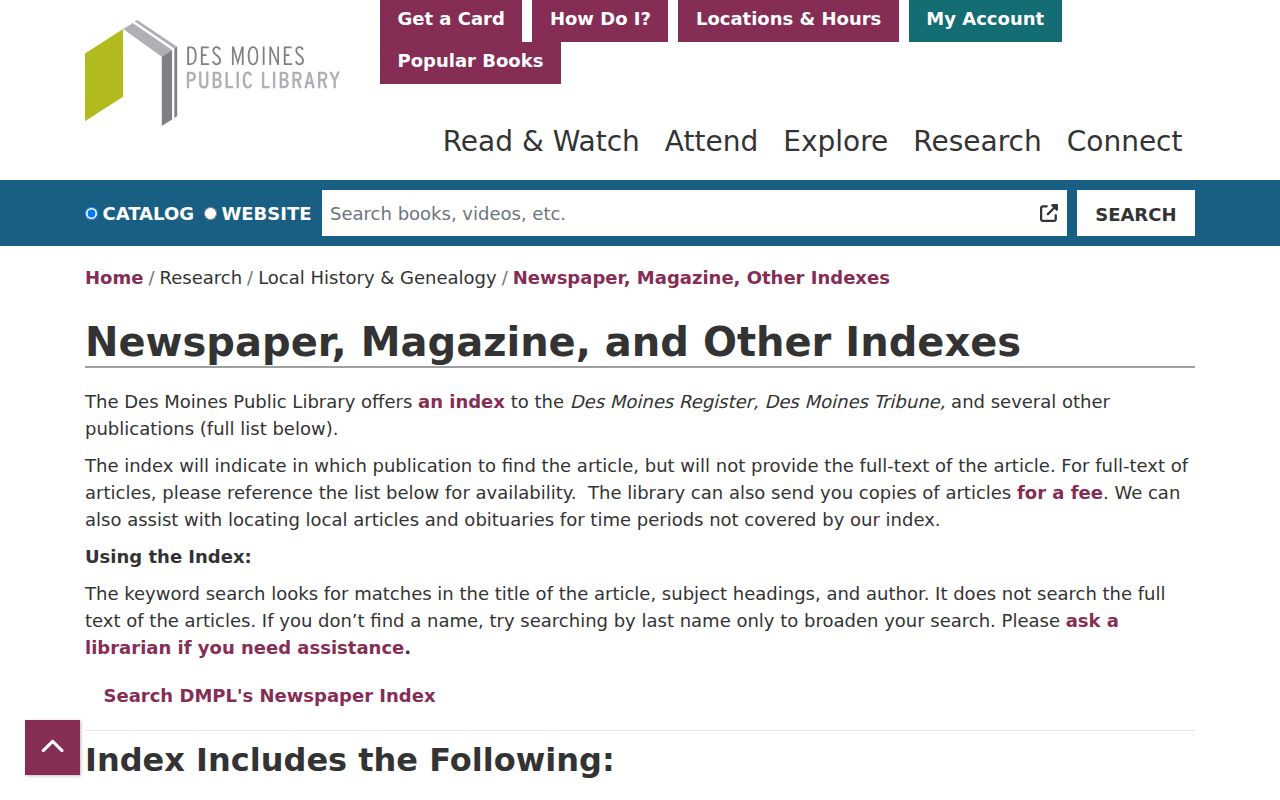
A directory entry can do more than sit on a page. The index turns a name, address, or employer into a focused newspaper article request. That opens a second record trail. The Des Moines Register archive reaches back to 1871. It runs to the present under the library's access terms. Strong searches pair a surname with Valley Junction, Fifth Street, Jordan House, or a railroad term. An old neighborhood name works too. Yearbooks and Historical Society files add classmates and civic ties. Take a directory line for exactly what it says, no more.
Iowa Archives Support City Directories
Another shelf waits at the state level. The State Historical Society's Polk County records hold material the local residents directory simply does not, including auditor name bonds from 1870–1907 and plat books that begin in 1870. School transfers dating 1848–1888 sit there too, along with an early district-court judgment docket. Each record answers a different question. A bond or a docket entry is not a resident listing, so treat it as a lead rather than proof someone lived in West Des Moines.
Archive work goes fastest when a gap can be narrowed first. Try a year, a county, a school series, a plat, or a court docket before requesting materials. Research centers operate in Des Moines and Iowa City. Archive appointments need five days of lead time. Library appointments need two days. The Iowa Genealogical Society reports roughly 20,000 books and 15,000 microforms. Everything stays on site, and the listed nonmember daily fee is $10. Its paid research service will not take living-person or adoption cases.
Trace West Des Moines Families
Each city directory is one dated snapshot. Start near a known event, such as a birth, marriage, or move. Copy the spelling, address wording, trade, and household marks exactly as printed. Work one volume at a time. A long jump can hide a move or the switch from Valley Junction to West Des Moines wording.
- Choose the year closest to a known birth, marriage, death, deed, school record, or news item.
- Search the surname and variants, then save the full entry and page.
- Check the street guide for that address and nearby house numbers.
- Repeat in the prior and next available years, noting moves and gaps.
- Pair directory years with census, obituary, deed, and archive records that define the person's role.
- Write “not found in this volume” when a search fails. Do not claim the person was absent.
Old directories build the dated household trail. For present addresses, turn to the West Des Moines streets resource instead. Assessor and deed records answer a different question about parcels and owners.
West Des Moines Directory Timeline
The known collections form a useful timeline without claiming a complete city-only run.
| Date or span | Collection milestone |
|---|---|
| 1866 and 1869 | Mills & Co. opens the documented digitized shelf. |
| 1871–1889 | Selected J.P. Bushnell years appear. |
| 1892–1922 | R.L. Polk supplies the listed digitized years, with gaps. |
| 1937–1938 | Valley Junction changes to West Des Moines while source terms shift. |
| 1957–present | Central Library holds Des Moines telephone books. |
| 1963–2002 | Polk Central Services lists suburban directories. |
| 1998–2002 | The named WDM/Polk City run provides a bounded local shelf. |
County lines, unlisted homes, short forms, missing editions, and postal labels can all bend a West Des Moines result. Read every match with those quirks in mind.